



- mediflows
- claim denial management
- June 10, 2026
- No Comments
Blog Details
Outsource medical billing services: a 2026 buyer's guide for practices that don't want to get burned
Most physicians did not go to medical school to chase insurance companies for money. Yet that is where a surprising amount of practice revenue is won or lost. A claim that goes out with the wrong modifier, a patient whose coverage lapsed last month, a denial that nobody followed up on within the appeal window — each one quietly drains the bottom line.
That is the problem medical billing services for physicians exist to solve. Done well, they shorten the time between seeing a patient and getting paid, recover money that would otherwise be written off, and take the administrative weight off clinical staff who already have enough to do.
This guide walks through what these services actually cover, why so many practices struggle with billing in the first place, and how to evaluate a billing partner without getting lost in vendor sales pitches. You will also find the benchmarks worth tracking and a checklist you can use during selection.
What Are Medical Billing Services for Physicians?
Medical billing services handle the financial side of patient care: turning a clinical encounter into a clean claim, submitting it, and chasing it until the practice is paid in full. Some practices hand over the entire revenue cycle; others outsource only the pieces they cannot staff well.
Core billing functions
The day-to-day work covers charge entry, claim submission, payment posting, patient statements, and follow-up on unpaid balances. A good biller also verifies eligibility before the visit, which is where a large share of denials can be prevented. These functions sound routine, but they are exactly where small errors compound into large write-offs.
Medical coding support
Accurate coding is the foundation of every paid claim. Medical coding services translate
documentation into CPT, ICD-10, and HCPCS codes that match what the provider actually did
and what the payer will reimburse. Specialty practices feel this most: cardiology, orthopedics,
and behavioral health all carry coding rules that a generalist biller can easily miss.
Claims management
Claims management is the full lifecycle: scrubbing claims for errors before submission, tracking them through the clearinghouse, and resolving rejections fast. The goal is a high first-pass rate so that money arrives on the first attempt rather than after weeks of rework.
Revenue cycle management
Revenue cycle management is the broader discipline that ties all of this together, from the moment a patient schedules an appointment to the final dollar collected. Strong RCM means fewer leaks at every stage: eligibility, authorization, coding, submission, denial recovery, and patient collections.
Why Many Physician Practices Struggle With Billing
Billing failures rarely come from one big mistake. They come from steady pressure that a small
team cannot keep up with
Increasing payer complexity
Every payer has its own rules, and those rules change constantly. Prior authorization requirements expand, documentation standards tighten, and a code that paid cleanly last quarter gets flagged this quarter. Keeping current with commercial plans, Medicare Advantage, and Medicaid is close to a full-time job on its own.
Staffing shortages
Experienced billers are hard to find and harder to keep. When a practice runs billing through one or two people, a single resignation or maternity leave can stall the whole revenue cycle. Accounts receivable balloons within weeks, and by the time a replacement is trained, timely-filing deadlines have already passed on some claims.
Coding errors
Coding mistakes are among the most common and most expensive errors in physician practice
billing. An unspecified diagnosis code, a missing modifier, or an upcoded service triggers
denials, delays, and in the worst case a compliance audit. Practices that lack certified coders tend
to leave legitimate revenue on the table simply because the documentation was not coded to the
right specificity.
Rising claim denials
Denials are trending the wrong way across the industry. Initial denial rates reached roughly 11.8% in 2024, up from about 10.2% a few years earlier, and many providers now report rates above that. The harder truth is recovery: more than half of denied claims from private payers are eventually paid when they are worked properly, which means practices that do not appeal are forfeiting money they already earned.
Consider a three-provider family medicine practice billing around $1.2 million a year. At a 12% denial rate, that is close to $144,000 in denied claims annually. If the practice only reworks the easy ones and lets the rest age past the filing deadline, even recovering half of what is recoverable can leave tens of thousands of dollars uncollected each year. None of that is new revenue. It is money the practice already earned by seeing the patient.
Benefits of Professional Medical Billing Services
The case for outsourced medical billing services comes down to predictable cash flow and fewer
dollars lost in the cycle.
Faster reimbursements
A dedicated billing team submits cleaner claims and works rejections daily, which shortens the gap between service and payment. For a practice living on monthly cash flow, cutting days in A/R from 55 to 38 is the difference between comfortable and constantly tight.
Reduced denials
Effective claim denial management starts before submission. Eligibility checks, authorization tracking, and claim scrubbing stop a meaningful share of denials at the source, while a structured appeals process recovers the ones that slip through. High-performing operations hold initial denials below 5%.
Improved collections
Healthcare billing services that follow up consistently on both payer and patient balances raise the net collection rate, often the single biggest lever on practice income. With patient responsibility rising under high-deductible plans, the collection process now matters as much as the payer side.
A practical example: a pediatrics group running a 91% net collection rate was effectively writing off about nine cents on every dollar it was owed. Tightening eligibility checks at the front desk and adding structured patient-balance follow-up moved that figure into the mid-90s within two quarters, with no change in patient volume.
Lower administrative burden
When billing moves off the front desk, clinical and reception staff stop splitting attention between patients and claim follow-up. That usually shows up as shorter patient wait times and fewer billing errors caused by multitasking.
Better compliance
Reputable medical billing companies build HIPAA safeguards, documentation standards, and coding audits into their workflow. That reduces the risk of an audit finding and keeps the practice aligned with payer and CMS requirements as they change.
In-House vs Outsourced Medical Billing Services
There is no universally right answer. The decision depends on practice size, specialty, and how much management bandwidth the owners want to spend on the revenue cycle. The comparison below covers the factors that matter most.
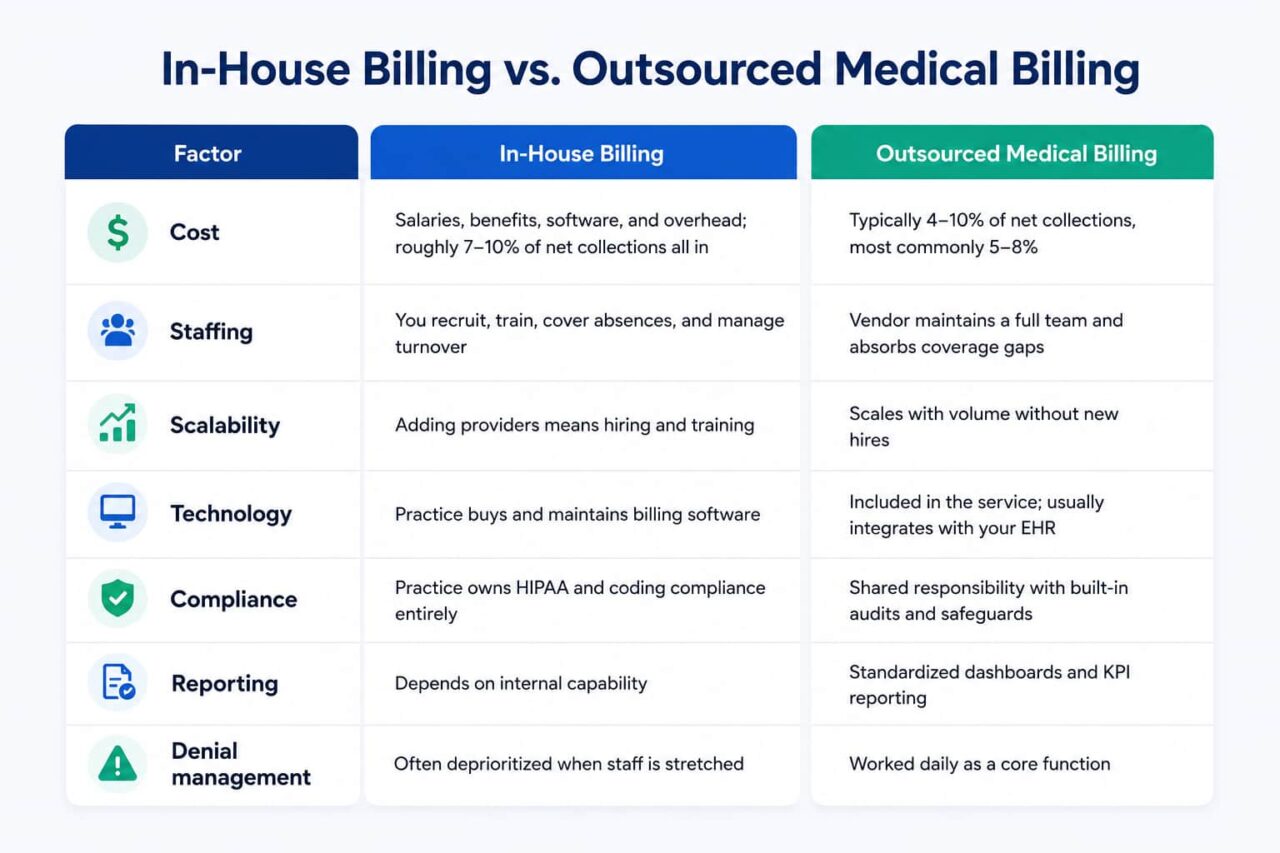
A solo or small practice with steady volume and a strong in-house biller may do fine on its own. A growing multi-provider clinic, or one carrying high A/R it cannot work down, usually gains more from medical billing outsourcing.
Key Features to Look for in a Medical Billing Partner
Not every medical billing company is built for physician practice billing. These are the features that separate a real partner from a claims processor.
Specialty expertise
Coding and payer rules vary widely by specialty. A partner that already works your specialty will know the modifiers, bundling rules, and common denials before they happen, instead of learning on your revenue.
Certified coders
Look for credentialed coders (CPC, CCS, or equivalent) rather than general data-entry staff. Certification signals that the people touching your claims understand documentation requirements and compliance risk.
Transparent reporting
You should be able to see clean claim rate, days in A/R, denial rate, and net collections at any time, not just in a quarterly summary. If a vendor is vague about reporting, that is usually a sign their numbers are not strong.
Technology integration
The billing service should connect to your existing EHR and practice management system rather than forcing a disruptive switch. Smooth integration keeps charge capture accurate and reduces manual re-entry.
Compliance processes
Ask how they handle HIPAA, internal coding audits, and payer policy updates. A partner with documented compliance processes protects you from the downstream cost of an audit or recoupment.
Typical Medical Billing KPIs Physicians Should Track
Whether you bill in-house or outsource, these metrics tell you whether the revenue cycle is healthy. Review them monthly and compare against industry benchmarks.
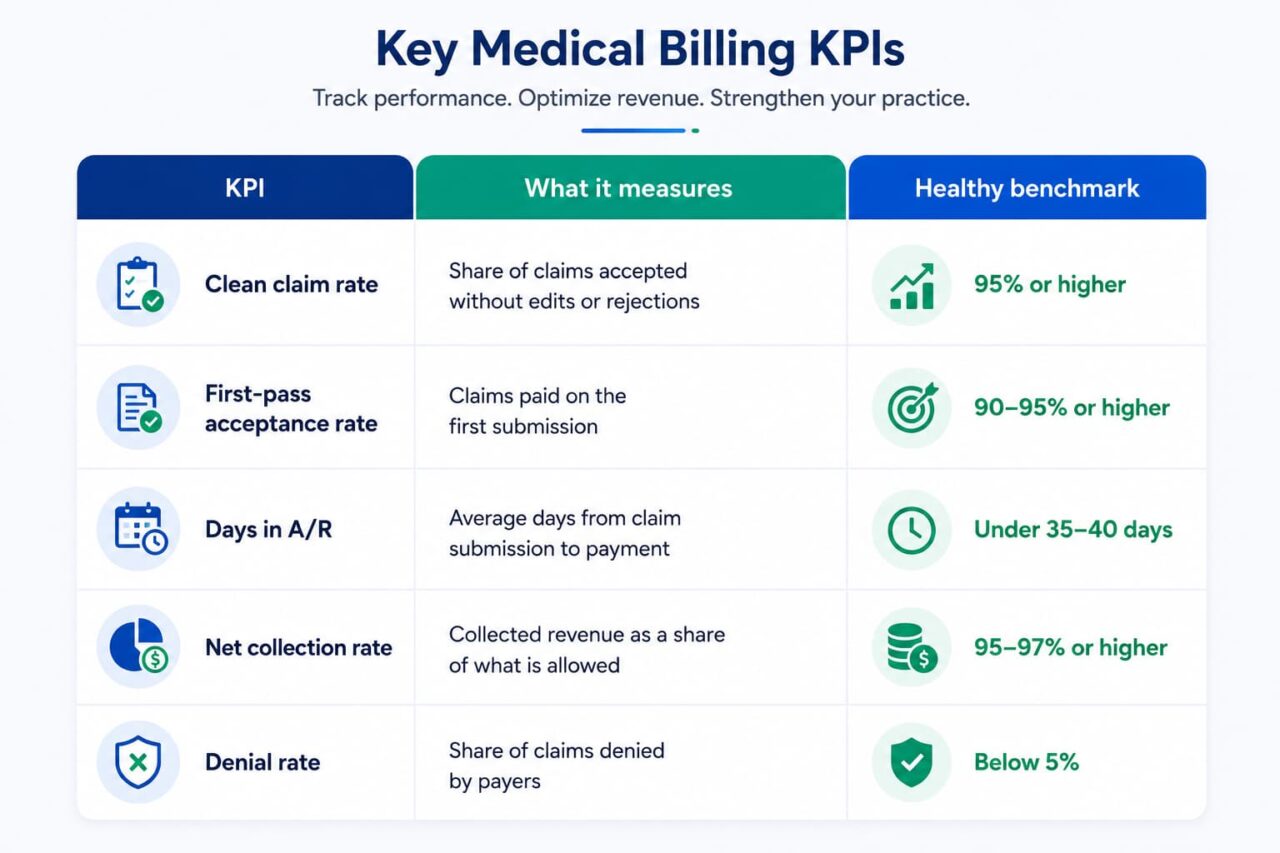
A clean claim rate below 90% points to coding or eligibility problems upstream. Days in A/R creeping past 45 usually signals weak follow-up or slow rework. And a net collection rate well under 95% means money the practice was entitled to is being written off or never pursued.
How to Choose the Right Medical Billing Company
Use this checklist when you evaluate vendors. The goal is to compare them on outcomes, not just price.
If you run a smaller office, our small practice billing guide covers the same evaluation tailored to one- and two-provider setups. For a deeper procurement walkthrough, the outsource medical billing services buyer’s guide compares pricing models in detail.
Final Thoughts
Medical billing services for physicians are not just back-office support. They decide how much of the money you earn actually reaches your practice. With denials rising and payer rules tightening, the gap between a strong revenue cycle and a leaky one keeps widening.
The practices that do best treat billing as a measurable operation: they track clean claim rate, days in A/R, and net collections, and they hold their billing team or partner accountable to those numbers. Whether you keep billing in-house or outsource it, that discipline is what protects your revenue.
If your A/R is climbing or denials are eating into collections, a focused review of your revenue cycle is usually the fastest way to find the leaks. Our team is happy to take a look.
FAQ
How much do medical billing services cost?
Most billing companies charge a percentage of net collections, typically 4–10%, with 5–8% being the most common range. Some use flat per-claim fees or a monthly per-provider fee instead. Pricing depends on specialty, claim volume, and how much of the revenue cycle you hand over. Setup or EHR integration fees may apply, commonly $300–$3,000.
Is outsourcing medical billing worth it?
For many practices, yes. Outsourcing usually lowers administrative burden, improves collections, and reduces days in A/R, and the gains often offset the fee. It tends to make the most sense for growing practices, those with high A/R they cannot work down, or offices that struggle to staff billing reliably.
How do billing companies reduce claim denials?
They prevent denials before submission through eligibility verification, authorization tracking, and claim scrubbing, then recover the rest through a structured appeals process. Since more than half of denied private-payer claims are payable when worked correctly, consistent follow-up is where much of the value lies.
Categories
Tag Cloud