



Medical Billing Services for U.S. Practices
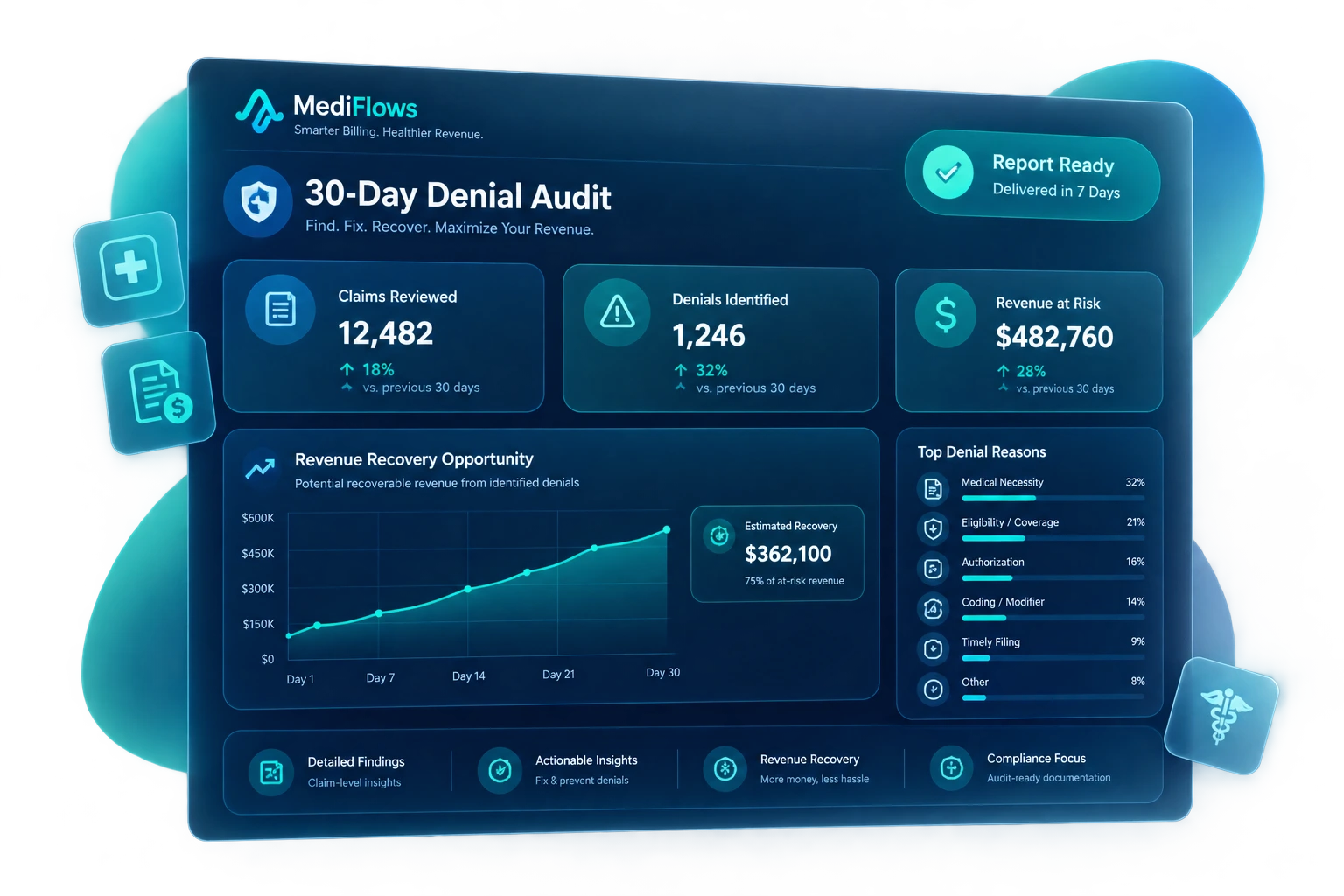
MediFlows Billing Solutions is a nationwide medical billing service handling coding, claim submission, denial management, and AR follow-up for practices in all 50 states. We start with a 30-day denial audit: a one-page report naming your top five denial reasons and the dollars stuck in each, delivered by day 7, before you sign anything.
Denial audit delivered day 7
- * URGENT CARE BILLING
- * FAMILY PRACTICE
- * RADIOLOGY BILLING
- * LABORATORY BILLING
- * MEDICAL BILLING
- * MEDICAL CODING
- * CLAIM SUBMISSION
- * DENIAL MANAGEMENT


What a medical billing service should hand you in the first month
Most billing companies start with a contract and show you results a quarter later. We start with a diagnosis. Your first deliverable is a one-page report on your last 30 days of claims: the five reasons payers gave for denying them, and the dollar amount sitting behind each reason.
That report is useful whether or not you hire us. If your largest denial category is a registration problem, no billing vendor fixes that for you. Your front desk does. You should know which one it is before you pay anyone.
After the audit you get a live claim dashboard, refreshed daily. Not a monthly PDF. A daily view of what has been submitted, what has been paid, and what is stuck.
The 30-day onboarding schedule
Day 1
Day 7
Day 14
Day 30
Most denials are administrative, not clinical
Practice owners tend to assume denials are arguments about medical judgment.
The payer-side data says otherwise.KFF’s March 2026 analysis of CMS Transparency in Coverage data, covering HealthCare.gov qualified health plans in the 2024 plan year, found that insurers denied 19% of in-network claims and 37% of out-of-network claims, for a combined average of 20% of all claims. Of the in-network denial reasons insurers reported, 36% were logged under “Other” with no reason specified, and 25% were administrative: duplicates, missing information, untimely filing, unapproved provider. Only 5% were based on medical necessity, and 9% were for lack of prior authorization or referral. A further 13% were for an excluded service.
Read that distribution again. The largest single category is a category that tells you nothing, and the largest category that does tell you something is paperwork.
Paperwork denials are the ones a billing service can actually move. Medical necessity denials require clinical documentation and a physician’s time. A duplicate claim or a missing subscriber ID does not.
The provider-side survey data points the same way. Experian Health’s State of Claims 2025 report, a survey of 250 healthcare professionals conducted in June and July 2025, found that 41% of providers say more than 10% of their claims are denied, up from 38% in 2024 and 30% in 2022. Sixty-eight percent said submitting clean claims is harder than it was a year ago, and 54% said claim errors are increasing. Twenty-six percent said at least one denial in ten at their organization traces back to errors made at patient intake.
The denial codes that carry most of the recoverable money
| Code | What the payer means | Where it originates | Who owns the fix |
|---|---|---|---|
| CO-16 | Claim lacks information or has submission errors | Patient registration and intake | Your front desk, with our checklist. We cannot prevent this from the outside. |
| CO-22 | Coverage may be primary under another carrier | Eligibility check not run, or coordination of benefits missed | Shared. Our eligibility step catches most of it. |
| CO-29 | Time limit for filing has expired | Claim sat in a work queue | Ours, fully, once we hold the queue |
| CO-45 | Charge exceeds the contracted fee schedule | Your fee schedule or the contracted rate | Usually not a denial at all. It is a contractual write-off. |
| CO-50 | Not deemed medically necessary by the payer | Clinical documentation | Your provider, with our appeal support |
| CO-96 | Non-covered charge | Plan benefit design | Shared. Determines whether the patient owes the balance. |
| CO-97 | Service is bundled into another paid service | Coding, usually an NCCI edit | Ours, fully |
Only CO-29 and CO-97 are fully ours to prevent. We say that out loud because a vendor that tells you it can eliminate CO-16 either does not understand where CO-16 comes from, or is hoping you do not.
If you want the detail on the individual codes, we have written each of them up: what CO-16 actually means and how to fix it, why CO-97 is a bundling problem, not a coverage problem, why CO-45 usually is not a denial at all, how CO-22 coordination of benefits works, and who actually owes the balance on a CO-96.
Your Trusted Partner for RCM & Medical Billing
HIPAA-Compliant Medical Billing
Our expert billing team manages every step of your revenue cycle with precision — from charge entry and coding review to claim submission and payment tracking. We help reduce errors, minimize delays, and keep your practice revenue flowing.
Claims Management & Denial Recovery
Prevent revenue leakage with proactive claim monitoring, denial analysis, appeals management, and payer follow-up. Our team works directly with insurance companies to resolve issues and maximize your reimbursements.
Complete Revenue Cycle Management
From eligibility verification and medical coding to accounts receivable management and payment posting, we provide end-to-end RCM services designed to improve cash flow and financial visibility.
Medical Credentialing
We manage applications, documentation, and payer requirements to keep the process moving smoothly.
Stay credentialed and focus on delivering quality patient care while we handle the paperwork.
Systems we work in
MediFlows works inside your existing EHR and practice management system rather than requiring a migration.
AdvancedMD · Allscripts · athenahealth · CollaborateMD · CureMD · DrChrono · eClinicalWorks · Kareo/Tebra · MedGen · NextGen · TherapyNotes · Office Ally
What the industry's numbers actually say, and who published them
Every figure on this page is reproduced below with its publisher, its year and its scope, so you can check it yourself.
| Figure | Source | Vintage and scope |
|---|---|---|
| 41% of providers report denial rates above 10%, up from 30% in 2022 | Experian Health, State of Claims 2025 | Survey of 250 healthcare professionals, June–July 2025 |
| 68% say clean claims are harder than a year ago; 54% say claim errors are rising; 26% trace one denial in ten to intake errors | Experian Health, State of Claims 2025 | Same survey |
| In-network denial rates range 3% to 36% by insurer | KFF | Same dataset. Hawaii averaged 27%, South Dakota 7%. Texas insurers ranged 12% to 36%. |
| $25.20 average cost to rework a denied claim | MGMA | Published benchmarking |
| 36% "Other", 25% administrative, 13% excluded service, 9% prior auth or referral, 5% medical necessity | KFF | Same dataset, plan-level denial reason reporting. A claim can carry more than one reason. |
| Fewer than 1% of denied claims are appealed; 66% of appeals are upheld by the insurer | KFF | Same dataset. 262,982 internal appeals against roughly 85 million in-network denials. |
| $43.84 per disputed claim (2022), $57.23 (2023), $118 for a formal appeal | Premier Inc. | Provider-reported administrative cost |
| 19% of in-network claims denied; 37% out-of-network; 20% combined | KFF | March 2026 analysis of CMS Transparency in Coverage data, HealthCare.gov QHPs, 2024 plan year, 496 million claims from 157 reporting insurers |
| $50,250 median annual wage, medical records specialists | US Bureau of Labor Statistics | Occupational Outlook Handbook, May 2024 |
Only CO-29 and CO-97 are fully ours to prevent. We say that out loud because a vendor that tells you it can eliminate CO-16 either does not understand where CO-16 comes from, or is hoping you do not.
If you want the detail on the individual codes, we have written each of them up: what CO-16 actually means and how to fix it, why CO-97 is a bundling problem, not a coverage problem, why CO-45 usually is not a denial at all, how CO-22 coordination of benefits works, and who actually owes the balance on a CO-96.
Our scale and reach to client satisfaction
Our Medical Billing Services
Our medical billing services help healthcare providers simplify billing, reduce claim denials, and improve revenue flow.
From claims processing to payment management, we handle the billing process so you can focus on patient care.
The MediFlows Advantage
Specialty and nationwide coverage
At MediFlows Certified coders work your claims, not a shared queue.
Specialty and nationwide coverage
MediFlows bills for practices in all 50 states. Coverage is national because payer rules are not, and a billing operation working across state Medicaid programs and multiple MACs sees policy changes earlier than one working a single market.
Specialty billing differs at the code level, not the marketing level. Cardiology reimbursement turns on the documentation elements separating one echocardiography code from the next and on professional versus technical component splits. Behavioral health turns on time-based psychotherapy code accuracy against the clinical note. Rehab turns on unit rules. Those are different failure modes, and the specialty pages should say so.
Switching from in-house billing or another vendor
A transition from in-house billing to MediFlows typically takes two to six weeks. Where a practice lands in that range depends on how clean the handoff is: system access, open AR at the cutoff date, and whether the outgoing biller is available to answer questions about aged claims.
We do not require a long-term contract. That matters most during a transition, because the period when a practice is least able to evaluate a billing partner is the period when a 24-month agreement locks it in hardest.
One thing to plan for is aged AR at the cutoff. Claims already denied before we take over keep burning their filing windows during the handoff. Decide explicitly who works them and put it in writing before day one.
We Support All Medical Specialties
Billing rules change from one specialty to the next. Our coders work to the payer rules, modifiers and documentation standards that apply to yours.
Family Medicine • Internal Medicine • Cardiology • Orthopedics • Neurology • Dermatology • Gastroenterology • Pediatrics • Psychiatry • Behavioral Health • Physical Therapy • Occupational Therapy • Chiropractic Care • Pain Management • Urgent Care • Radiology • Laboratory Services • Home Health • Urology • ENT • Ophthalmology • General Surgery • Anesthesiology
FAQ's about the Service
How much do medical billing services cost?
Is outsourcing medical billing cheaper than hiring in-house?
What percentage of claim denials are actually preventable?
How long does it take to switch billing companies?
What is a good clean claim rate?
What happens to my old denied claims when I switch?
Do I have to sign a long-term contract?
What does the 30-day denial audit include?
I am opening a new practice. When should billing start?
About Us
Mediflows has been offering comprehensive billing and revenue cycle solutions across a wide range of specialties all over USA.
Contact Info
Serving All Across The United States